Phoenixes are representative of renewal, rebirth, a fresh start, so it felt appropriate to kick off the new year with a closer look at a story featuring one.
“The Firebird and Princess Vasilissa” comes from Russian Fairy Tales (or Russian Folk Tales). It is one of the largest collections of fairy tales in the world, featuring over 600 stories across 8 volumes from Russia, Ukraine, Belarus, and the surrounding areas. The stories were collected and published by Alexander Afanasyev between 1855 and 1867. A translation of “The Firebird and Princess Vasilissa” can be found here, if you want to read it yourself.
The story opens with a powerful tzar in a far away country, though he’s not the hero in the story. The hero is a man employed by the tzar, an archer who, though young, has a “horse of power” like the heroes of old. While out riding one day, the archer comes across a beautiful forest setting, but to his shock, he can hear no birds. What he does find is a large golden feather, and he realizes a firebird has flown by recently. The horse (who can speak) cautions the archer to leave the feather where it is, warning him that if he does, he will “know the meaning of fear.” Still, the temptation of the tzar’s favor proves too much, and the archer disregards the horse’s words, picks up the feather, and takes it to the tzar.
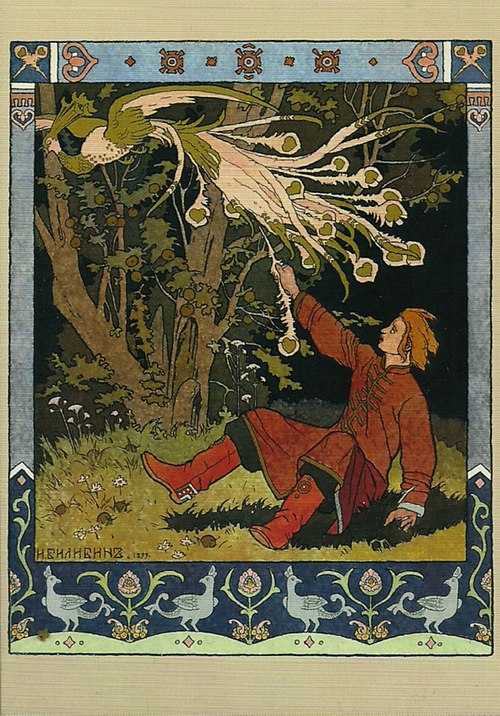
The tzar is intrigued by the feather, but far from satisfied. In fact, he demands that the archer bring him the bird itself, not just a feather. After all, if he got the feather so easily, the bird should be no trouble. But if he dares return without the bird, well then, the tzar will just have to cut his head off.
The archer runs crying to his horse, who (though rather smug that it had been proven right) is sympathetic to the archer’s plight and offers him a way to find and catch the firebird. Sure enough, with the horse’s help, the archer is able to catch the bird and present it to the tzar. Of course, the tzar isn’t satisfied with the offering, rare and wondrous as it is. Since it was so easy for the archer to catch the firebird, the tzar reasons, he should therefore be able to just as easily bring the tzar his desired bride: Princess Vasilissa, who lives on the edge of the world in the land of Never. Again following the horse’s advice, the archer is able to spring a trap, and he soon brings back the (sleeping) princess.
The tzar wastes no time in setting up the wedding, and the poor princess is woken up by trumpets and bells announcing the match. Although she presumably recognizes the archer as the last person she saw before falling asleep and waking up in an entirely new place, she does realize he rides a horse of power and that he is young and attractive – certainly more so than the tzar, who strikes her as unkind. So Vasilissa falls in love with the archer and devises a way to put off her marriage to the tzar, setting an impossible task of her own before the wedding can occur. To no one’s surprise, the tzar wastes no time in instructing the archer to accomplish the deed in his stead.

The task yet again done with the guidance of the horse (and the aid of a whole lot of lobsters), the archer reluctantly returns, hating that he’s helping the tzar wed the princess, who he himself now loves. The princess asks for one final thing: that the man who kidnapped her (that’s not the language used, since she now loves him, but it’s absolutely what happened) do “penance in boiling water.” Servants set up a cauldron, and before long, it’s full of boiling water. While piteously reflecting on the events that led him to that point, the archer thinks of his horse. He begs the tzar to let him see his horse one last time, privately hoping it will have an answer for this problem like it did for all the others.
Sure enough, the horse has an answer, though a strange one. The archer must embrace his fate and run and jump into the boiling water without hesitation. The princess approaches the cauldron to check if the boiling water is hot enough and presumably does something to the water, though it’s never explicitly said what. Trusting in his horse, the archer does indeed jump into the water. He bobs up and down a few times, unharmed by the searing heat, and emerges even more beautiful than he was before. The tzar, jealous of the transformation, jumps in next. He, however, is instantly boiled to death.
The archer is made the new tzar, he marries Vasilissa, and the pair live happily ever after. The archer-turned-tzar also constructs a golden stable for his horse and never forgets what he owes his friend.
Fun Fact #1
Firebirds often feature in Russian folklore, said to bring good and bad luck in equal measure, sometimes directly and sometimes indirectly.
Fun Fact #2
Much like firebirds, Vasilissa is a common name throughout Russian tales. There are Vasilissas who are princesses and heroes, who are wise and foolish, similar to Jack in English stories.
Fun Fact #3
It’s really not clear why the archer survived his trial by boiling water. It’s hinted that Vasilissa may have done something to the water, though why it only saved the archer isn’t clear. Or maybe the horse did something to protect its master. Alternatively, it may be a classic fairy tale case of the good character being rewarded and the bad one being punished by more supernatural means.
Recommendation
I feel like I’ve been talking about ballets an unusual amount recently, but today’s recommendation is another one because there aren’t really any retellings of this story that I could find (which is a shame). But I highly recommend the ballet ‘The Firebird.’ It’s more based on another firebird tale, “Tsarevich Ivan, the Firebird and the Gray Wolf”, but it shares a lot of similarities with “The Firebird and Princess Vasilisa”. It’s a short production, under an hour, and you can easily find it on YouTube. It was composed in 1909 by Igor Stravinsky and is the piece that catapulted him into international fame.
Are there any fairy tales you’d like to see me cover here? Leave them in the comments!
Until next time, word nerds!
 Kate G. Jameson