I’ve said before that fairy tales, as they were originally told and shared, weren’t strictly for kids. However, they certainly have become synonymous with children’s literature today. There are myriad reasons for that, but I wanted to take a closer look at one of them today: The Lang Fairy Books.
Andrew Lang was born in 1844 in Selkirk, Scotland. He was raised on local folklore, which formed in him a great love of literature. He founded a literary magazine at his school and had a great interest in history and anthropology, which led him to his interest in and translations of The Iliad and The Odyssey, which are still much admired today.
Arguably, his greatest literary contribution was a collection of 12 collections of fairy tales, often called the Colored Fairy Books because they assign a color to each one (The Blue Fairy Book, The Lilac Fairy Book, etc.). These 12 books made up half of a 25-book collection of stories for children. Some were books of poetry, some stories of real people, but the bulk of them were fairy tales. These fairy tale books, more than any others in the past, were created to be marketed to children. The prefaces Lang wrote directly addressed his young readers, and each book included intricate illustrations to appeal to young minds and imaginations.
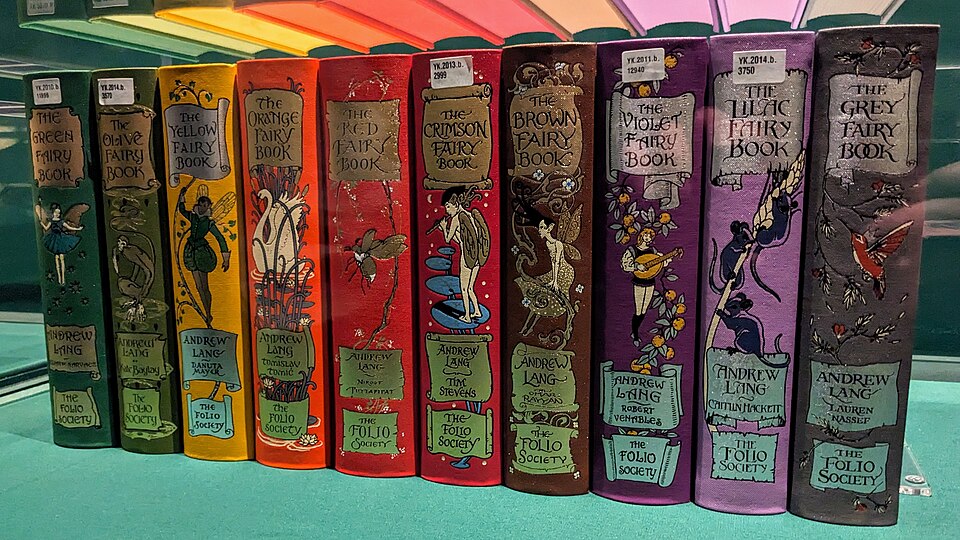
These wildly popular books made a name for Lang in the genre, much to his chagrin. In 1910’s The Lilac Fairy Book (the last of the colored series), he admits to being distraught at the idea that he was the “writer” of so many fairy tales. Indeed, he was adamant that he was merely a collector of stories that had existed for much longer than he had, stories that were told for generations before being recorded by other people. His only real role was bringing them into a single collection, and though he wrote a handful of original works, they were not the books he was known for. Still, he appears to have been instrumental in the idea of adapting fairy tales specifically for children.
In that last book’s preface, we get an interesting tidbit: Lang admits that the lion’s share of the work done on the fairy tales – translating, editing, and adapting them for a younger audience – was actually done by his wife. She had been credited in previous books as one of the translators, and in The Olive Fairy Book (1907), Lang says, “Mrs. Lang, except in cases mentioned, has translated and adapted to the conditions of young readers the bulk of the collection.” Still, Lang had been the one on the cover of the fairy books, though many of the other works in the same vein (The Book of Princes and Princesses and The Red Book of Heroes, to name a few) are credited to her, with Andrew being noted as her editor.
Leonora Blanche Alleyne was born in Bristol 1851, and she married Andrew Lang in 1875. While she also appeared to have had an interest in literature, languages were her speciality. Andrew credits her for translating stories from a variety of languages, including French, German, Portuguese, Italian, Spanish, and more. As the pair continued the fairy series (with a number of other translators), she seems to have taken on more and more of the work, both of translating and adapting the stories. Notes from later prefaces state outright that Mrs. Lang changed some of the stories, making them more appropriate and palatable for children.

The Langs’ Fairy Books were instant classics, and even today, they are regarded as the standard for English fairy tale translations. Since they were created for children, it’s no wonder the fairy tale has become a staple of children’s literature.
Did you have a favorite fairy tale growing up? Leave it in the comments below!
Until next time, words nerds!
 Kate G. Jameson