I recently moved a long way from home. I don’t know anyone in this new place and I’m worried about settling in and being all own my own. Do you have any tips for making friends and not feeling quite so out of place?
Wow, it’s been a while since I’ve done one of these. On the recommendation of my friend Julie, I’ll be talking about Thumbelina today.
Thumbelina, or Tommelise as it was titled in the original Danish, was written by Hans Christian Andersen as a part of his first collection of fairy tales in 1835 and not well received by critics at the time. It was translated into English in 1846 by Mary Howitt and started gaining popularity.
I love this fairy tale, even if I sometimes forget about it. I highly recommend you read it if you have the time. It’s not long. In fact, one might say it’s tiny (that’s a joke that will make sense soon, I promise).
So I forgot how busy I was going to be this weekend and didn’t work ahead. Hence, no video this week. And I’ll be gone next week, so no video then either. Sorry!
But I still wanted to give you a reading recommendation, so you get this quick post.
My March author crush is Jackson Pearce. She writes fantasy stories, spy books, and fairy tale retellings. You can find out more about her on her website.
Depending on who you are and how you grew up, you might have mixed reactions to the name.
Some of you might sigh romantically, picturing your own version of the perfect man who you hope to meet some day.
Some of you might sigh in frustration, cursing those stories and movies that have set impossibly high standards of romance and relationships for men and women, because you know that no one is that perfect.
Others of you, like myself, might raise an eyebrow and snarkily ask “Which one?”
Princes are one of the more popular types of fairy tale characters. I’ve talked about them before, specifically how Disney handles their portrayal, but I wanted to explore their characters a little more deeply.
As you may know, I recently graduated college and moved home. I found myself unpacking things that had been either at college or in boxes in our basement for the first time in three and a half years.
And I realized I had a lot more stuff than I thought.
This was most noticeable in my bookshelf. I unzipped my small suitcase (yes, I pack my books in a suitcase, don’t judge me) only to find I had no room on my bookshelf for them.
So I began the terrifying and slightly painful task of choosing which books to keep and which to get rid of.
Now, I’ve always been one of those people who hoards books. I love getting new ones and I hate giving away old ones. So this is a project that my mom tries to encourage me in every few years. And every time, I’d manage to part with five or six books. Unfortunately for me, I had at least fifteen books with me at college and and a full bookshelf with not enough room.
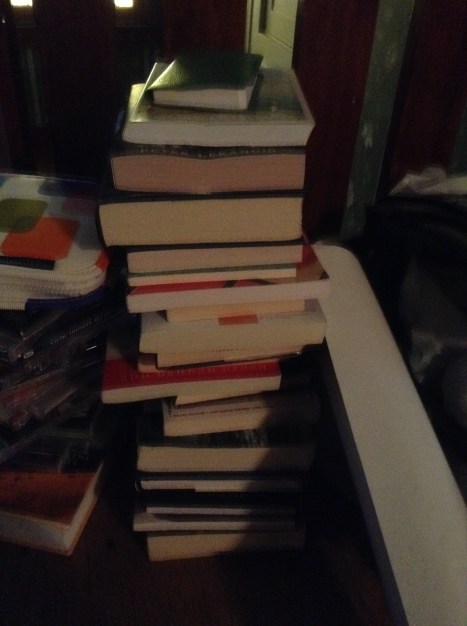
I eventually managed to weed out books I no longer read or need, as hard as it was. And it was a bigger stack than I thought it would be.
Books, CDs, notebooks…I cleaned out a lot of things.
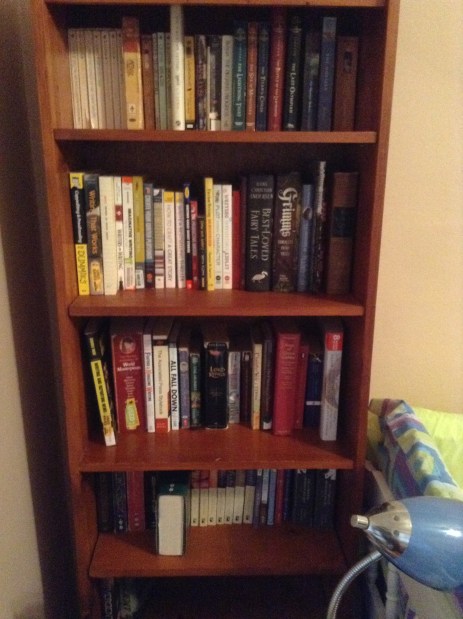
It might have been hard to let go of my precious books (even if they were ones I didn’t particularly like), but there was something satisfying about rearranging my bookshelf. I had the space to reorganize my books and now I have space for the new books I will inevitably buy in the future.
Doesn’t it look nice?
I cleaned out a lot of clutter after moving home. I got rid of old and empty notebooks (I hoard notebooks like a squirrel hoards nuts), CDs that have long since been uploaded to my computer, and clothes I don’t wear anymore.
It’s not easy, clearing out things that I’ve been used to having or have even become attached to. But it’s left me feeling refreshed, like I have room to grow, new opportunities to explore.